How to Write Survey Questions That Get Honest Answers
One idea per question, neutral wording, balanced options and the right order: how to write survey questions people answer honestly, with Pew's research.

Shaheer Malik
Framer Designer & Developer
Quick answer
Ask about one thing per question, in plain words, without hinting at an answer. Offer balanced choices with "not sure" or "something else", ask about real recent behaviour, and put sensitive questions after easy ones.
Survey questions get honest answers when they ask about one thing, in plain words, without hinting at the answer you want. Offer balanced answer choices that include "not sure" or "something else", ask about real past behaviour rather than vague opinions, and put sensitive or opinion questions after easy ones. Small wording changes can shift results by double digits, so test your questions on a few people first.
I make Forms, a survey and form builder. The research below is from Pew Research Center, which runs some of the most carefully designed surveys in the world, read on 4 October 2026.
Why does question wording matter so much?
Because people answer the question you asked, not the one you meant. Pew Research Center's guide to writing survey questions gives a striking example from 2003. When people were asked whether they'd favour or oppose military action in Iraq, 68% said they favoured it. When the question added that it could mean thousands of American casualties, support fell to 43%. Same topic, different words, a 25-point gap.
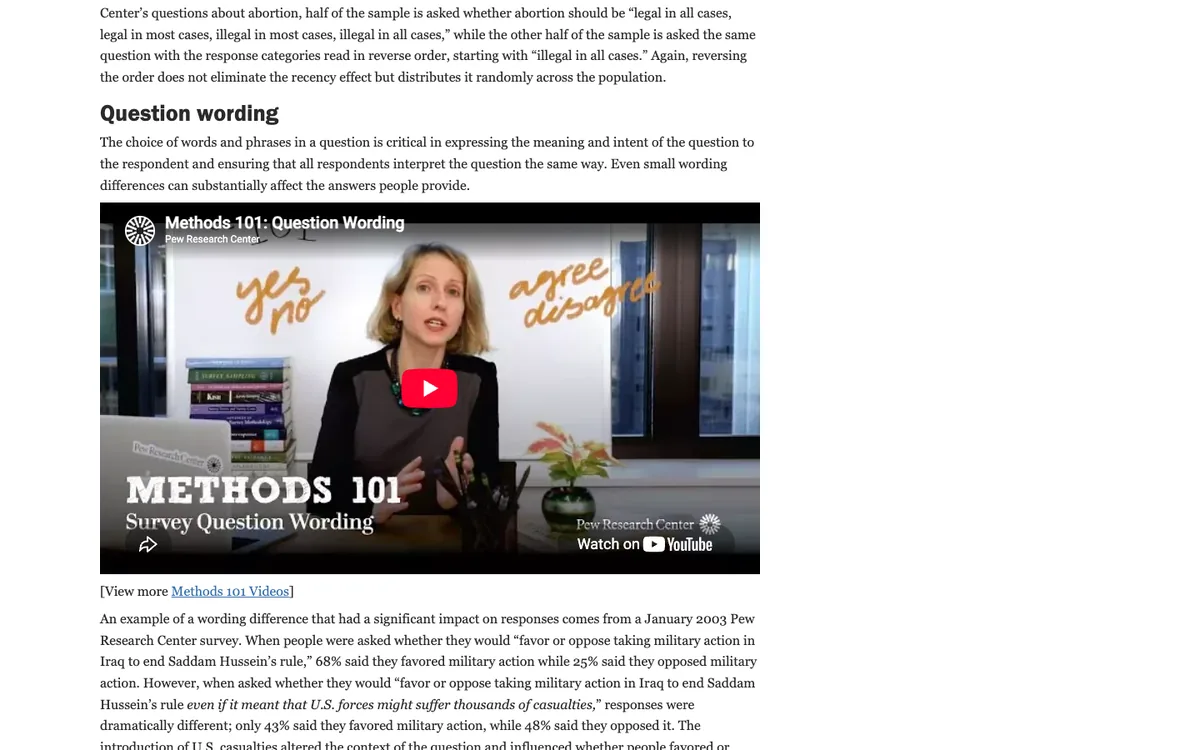
Your product survey won't be about war, but the effect is the same. A question that hints at the answer you want gets that answer.
What are the most common question mistakes?
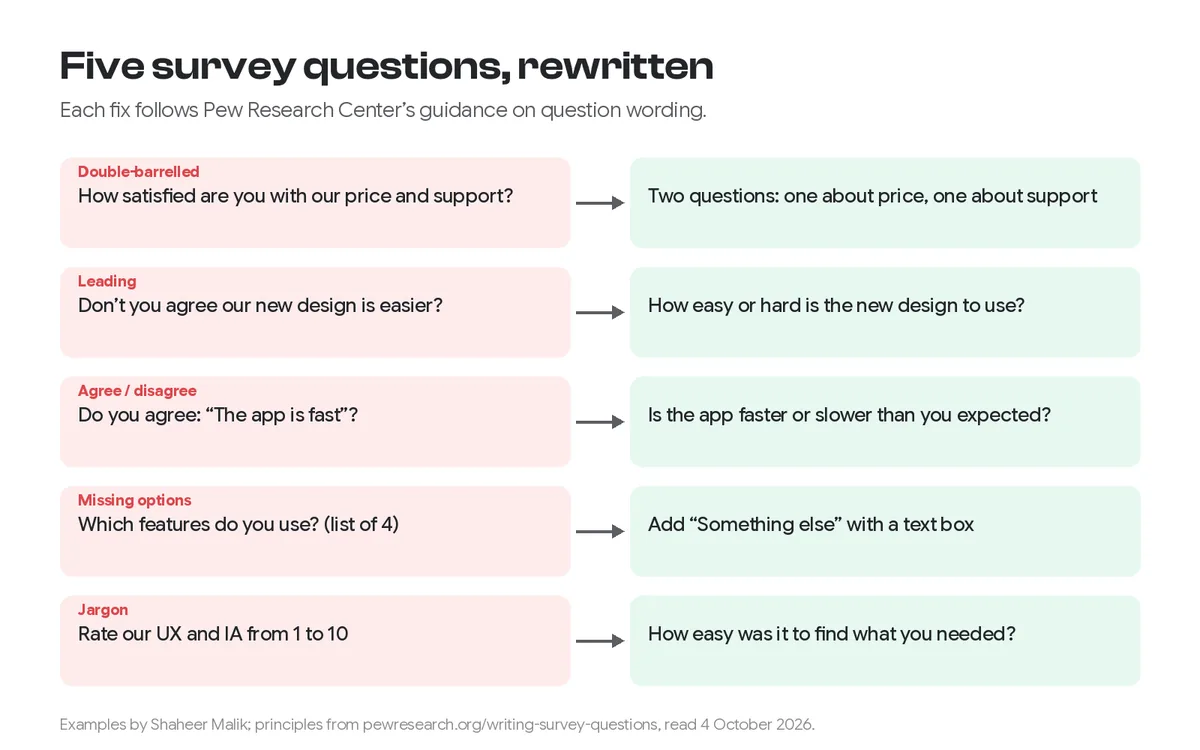
| Mistake | Example | Better |
|---|---|---|
| Double-barrelled | How satisfied are you with our price and support? | Two questions: one about price, one about support |
| Leading | Don't you agree the new design is easier? | How easy or hard is the new design to use? |
| Agree/disagree | Do you agree: "The app is fast"? | Is the app faster or slower than you expected? |
| Missing options | Which feature do you use most? (four choices) | Add "Something else" with a text box, and "I don't use any" |
| Jargon | Rate our UX and IA from 1 to 10 | How easy was it to find what you needed? |
| Vague time frame | Do you exercise regularly? | In the last 7 days, on how many days did you exercise? |
Pew's guidance covers the first three directly. Double-barrelled questions combine two ideas and produce answers you can't interpret. Agree/disagree formats encourage people to agree, which researchers call acquiescence bias. Pew's alternative is to offer a choice between statements.
Should I use open or closed questions?
Use both, for different jobs, and know that the format changes the answers. Pew found that in a 2008 election poll, 58% chose "the economy" as the most important issue when it was offered as an option, but only 35% volunteered it when the question was open. In the open version, 43% gave an answer that wasn't on the closed list at all, against 8% in the closed one.
So:
- Use open questions to discover what you don't know: "What nearly stopped you from signing up?"
- Use closed questions to measure what you do know, with options drawn from earlier open answers.
- Always offer an escape: "Something else" with a text box, or "Not sure".
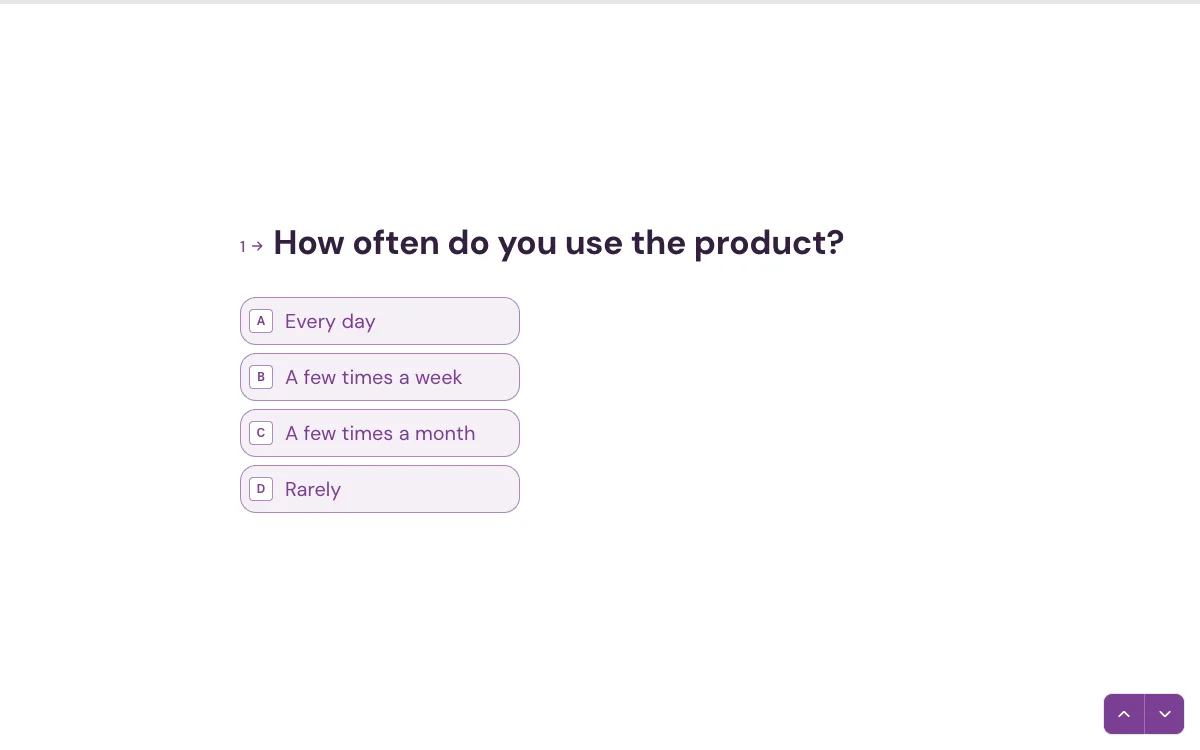
Does the order of questions and answers matter?
Yes, both. Earlier questions set the context for later ones: Pew describes a 2003 poll where support for legal agreements for same-sex couples was 45% after a question about marriage, against 37% without it. For your survey, that means:
- Easy, factual questions first (what they use, how often), opinions later.
- Ask the general question before the specific one. Overall satisfaction comes before satisfaction with support, or the support question colours the overall one.
- Sensitive questions last. People who've answered ten easy questions are more likely to answer one about income.
Answer order matters too. Pew notes that people reading a list tend to pick options near the top, so it randomises the order of unordered choices across respondents. Keep the natural order for scales, such as poor to excellent.
How do I get honest answers about sensitive topics?
- Say who sees the answers, and that it's anonymous only if it truly is.
- Use ranges, not exact figures, for income, age or spending.
- Normalise the honest answer: "Many people haven't tried this yet. Have you?"
- Don't ask for details you don't need. Every unnecessary personal question lowers trust in the rest.
Forms doesn't store respondents' IP addresses and puts no tracking cookies on public forms, which makes "we don't track who you are" easier to promise. Just don't collect names or emails in the same survey if you call it anonymous.
How long should a survey be?
As short as your questions allow, and honest about it. Say on the first screen how many questions there are or how long it takes, and make sure it's true. People are far more patient with a long survey they were warned about than a short one that keeps going. Every question should earn its place: if you can't say what you'll do differently depending on the answer, cut it.
How should I set up rating scales?
- Label the ends, such as "Very hard" and "Very easy", so a 2 means the same thing to everyone.
- Keep one direction throughout the survey. Don't make 1 the best on one question and 5 the best on the next.
- Use the same scale for questions you'll compare, such as ease of setup and ease of daily use.
- Offer "Not applicable" when some people genuinely can't answer, rather than forcing a middle score that looks like an opinion.
In Forms, opinion scale and NPS questions have labels for both ends that you can edit, so you can follow these rules without workarounds.
How do I test a survey before sending it?
Ask three to five people to take it while thinking aloud, and watch where they hesitate. Nielsen Norman Group's guide to qualitative surveys is a good companion read on open questions. Look for questions people reread, answers that don't fit any option, and places they ask "what do you mean by…?". Fix those, then send it.
After it's live, check which questions people abandon on. My guide to finding your form's drop-off question shows how, and 25 customer feedback questions gives ready-made wording.
Last updated: 4 October 2026. Build your first form free, no card needed, or talk to me about your project.
FAQ
Frequently asked questions
It asks about one thing, uses plain words, does not hint at the answer, offers balanced options including "not sure" or "something else", and asks about a specific time frame or real behaviour where possible.
Want it done for you? I offer website design on a fixed price, from $700. See pricing.