Free NPS Survey Template, and How to Calculate Your Score
How Net Promoter Score works, how to calculate it with a worked example, what to ask after the score, and a free three-question NPS template.

Shaheer Malik
Framer Designer & Developer
Quick answer
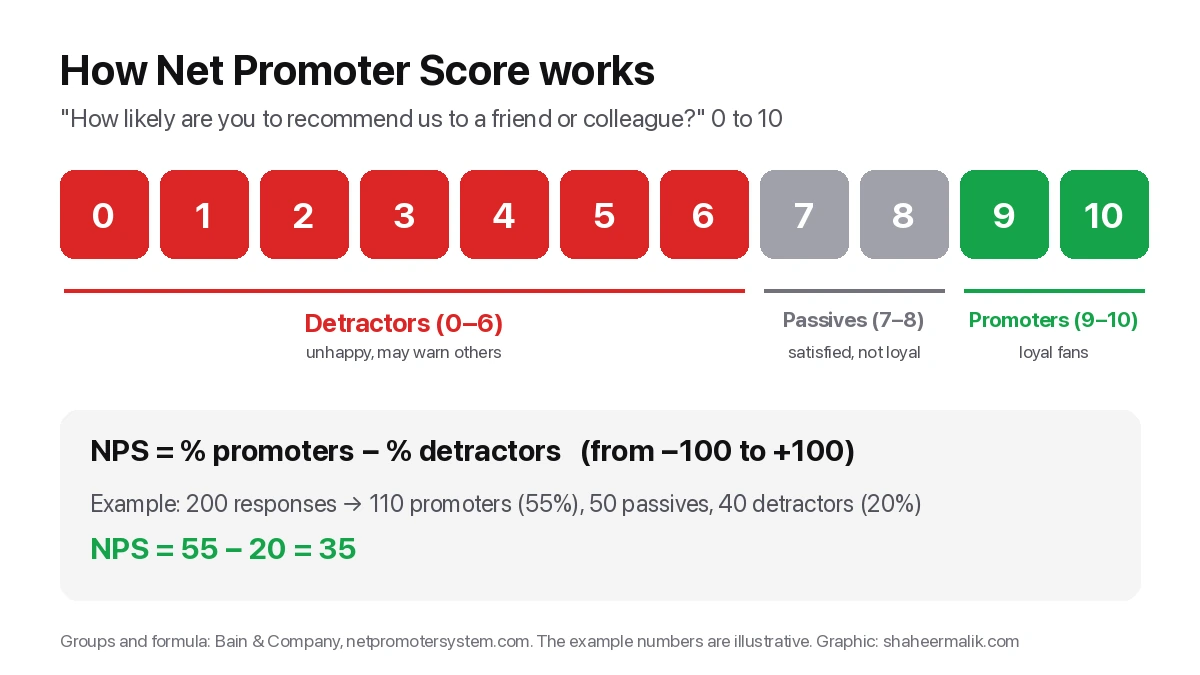
Net Promoter Score asks how likely people are to recommend you on a 0 to 10 scale. Promoters answer 9 or 10, passives 7 or 8, detractors 0 to 6. NPS is the percentage of promoters minus the percentage of detractors, from -100 to +100.
Net Promoter Score (NPS) asks one question: "How likely are you to recommend us to a friend or colleague?" on a 0 to 10 scale. People who answer 9 or 10 are promoters, 7 or 8 passives, and 0 to 6 detractors. Your NPS is the percentage of promoters minus the percentage of detractors, so it runs from -100 to +100. A free three-question template is below.
Disclosure: I make Forms, the form builder whose templates appear below. The methods here work in any tool, and every outside figure links to its source.
What is Net Promoter Score?
NPS is a loyalty measure built on a single question. Fred Reichheld introduced it in the Harvard Business Review article "The One Number You Need to Grow" in December 2003, arguing that one recommendation question could stand in for long satisfaction surveys. It's now one of the most common customer metrics in business.
Net Promoter, NPS and Net Promoter Score are trademarks of Bain & Company, Inc., NICE Systems, Inc. and Fred Reichheld.
How do you calculate NPS?
Group every answer, then subtract. Bain & Company's Net Promoter System defines the three groups and the formula:
| Score | Group | What it usually means |
|---|---|---|
| 9 to 10 | Promoters | Loyal customers likely to recommend you |
| 7 to 8 | Passives | Satisfied, but open to a competitor |
| 0 to 6 | Detractors | Unhappy, and may put others off |
NPS = % promoters - % detractors. Passives count in the total but not in either group.
Can you show a worked NPS example?
Say 200 customers answer. 110 give a 9 or 10, 50 give a 7 or 8, and 40 give 6 or lower.
- Promoters: 110 of 200 = 55%.
- Detractors: 40 of 200 = 20%.
- NPS: 55 - 20 = 35.
Note that NPS is a whole number, not a percentage. If every customer were a promoter, the score would be +100; if every customer were a detractor, -100.
What is a good NPS score?
Any score above zero means you have more promoters than detractors, but "good" depends on your industry and your own history. Bain notes that companies achieving long-term profitable growth have an NPS about twice that of the average company. The most useful comparison is your own score over time, measured the same way.
Be careful with small samples. With 20 responses, one customer moves your score by five points, so wait for enough answers before you react to a change.
What should the NPS survey ask after the score?
One follow-up that depends on the score. The number tells you where you stand; the follow-up tells you why. A good pattern:
- Promoters (9 to 10): "Glad to hear it! What do you love most?"
- Passives and detractors (0 to 8): "What's the one thing we could do better?"
Keep the follow-up optional. People who only want to give a number still count, and those who write are telling you something they care about.
Where can I get a free NPS survey template?
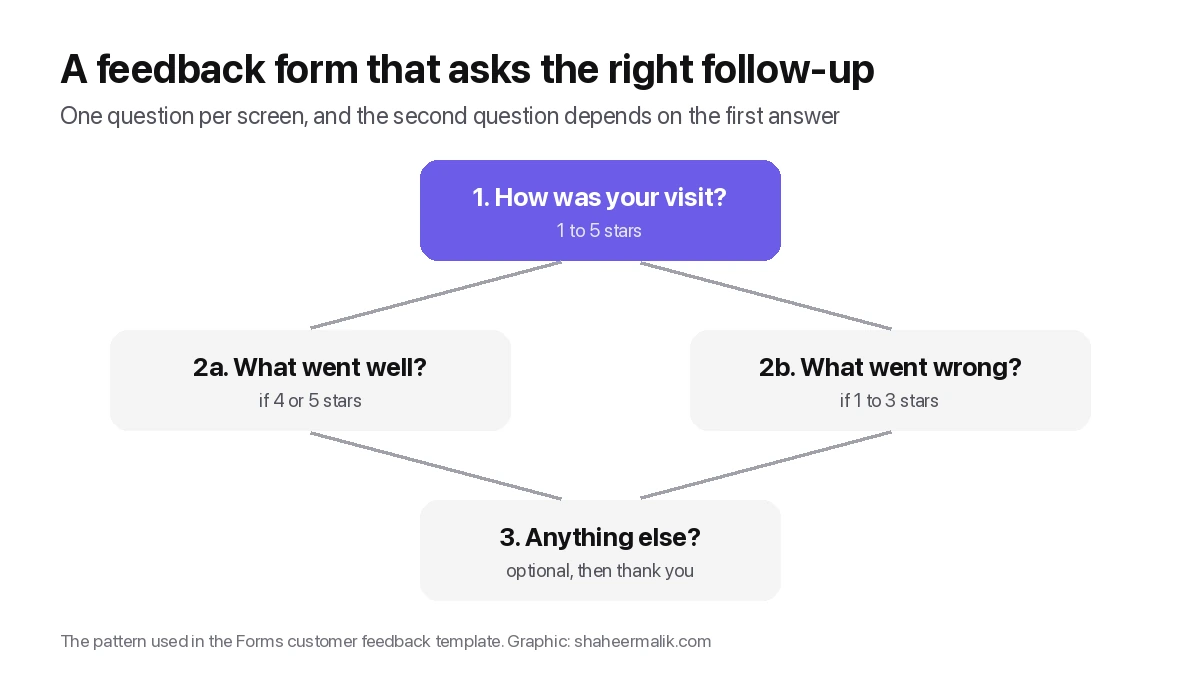
The Forms NPS survey template is three questions and takes about a minute: the 0 to 10 recommendation question, then one of the two follow-ups above, chosen by logic based on the score.
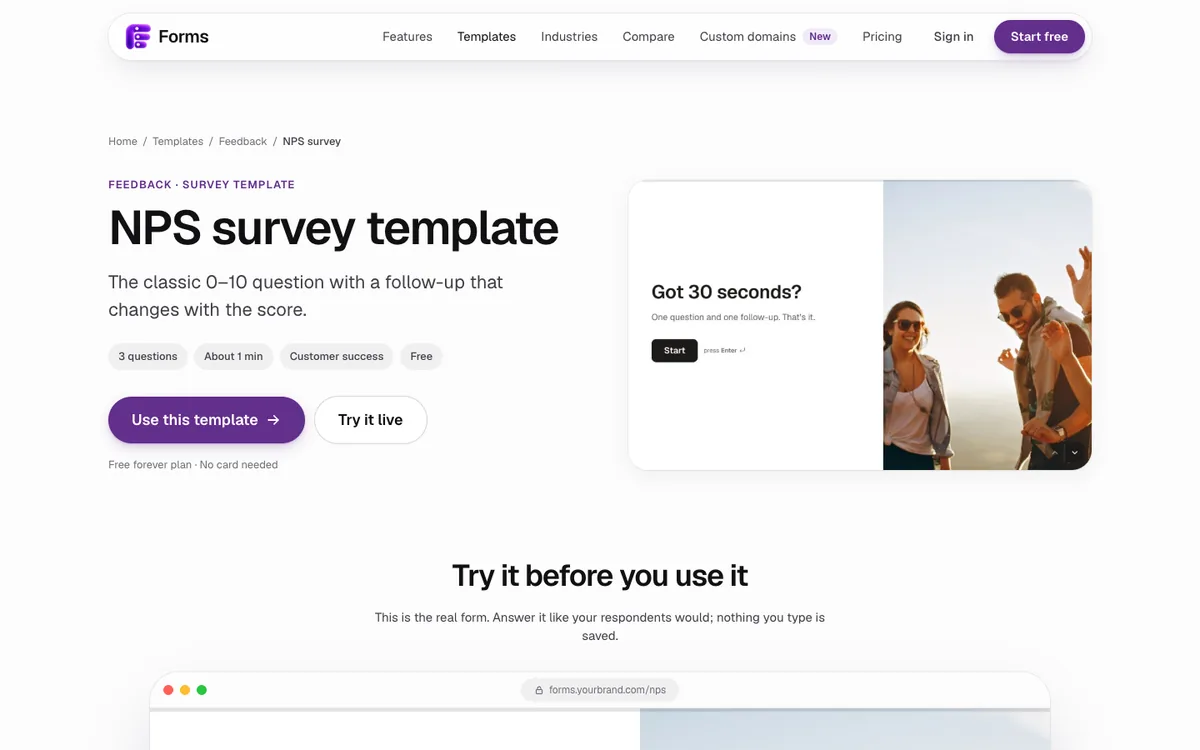
It's free on the Forms Free plan, which includes one active form and 100 responses a month. You can embed it on your site, send it as a link, or put it in a QR code, and send every response to Google Sheets. Because Forms stores no IP addresses and sets no tracking cookies on public forms, it works for anonymous surveys.
When should you send an NPS survey?
NPS works in two modes, and they answer different questions.
- Relationship NPS: sent on a schedule, such as every quarter, to measure loyalty overall. Keep the timing consistent so scores are comparable.
- Transactional NPS: sent right after a moment, such as a purchase or a support conversation, to measure that experience.
Don't survey the same person too often. Asking every week trains people to ignore you, and the people who still answer aren't typical.
How is NPS different from CSAT?
NPS measures loyalty to your company over time; CSAT measures satisfaction with one interaction. CSAT is usually asked on a 1 to 5 scale and reported as the share of people who answer 4 or 5, as Qualtrics explains. Use CSAT after a support conversation and NPS on a regular schedule.
Is NPS enough on its own?
No. NPS tracks loyalty, not satisfaction with a specific moment, and it can't tell you what to fix without the follow-up answers. Pair it with a satisfaction question after key moments and read the comments every time. My list of 25 customer feedback questions has the rest.
How do you run an NPS survey, step by step?
Five steps, and the first matters most.
- Decide what you're measuring. Loyalty overall (relationship NPS) or one experience (transactional NPS). Don't mix both in one survey.
- Pick who you ask. Customers who have used your product or service enough to have an opinion. New sign-ups can't tell you much yet.
- Send it where they already are. An email after an order, a link in your app, or a form embedded on your account page.
- Count, then read. Calculate the score, then read every comment, sorted by group. Detractors' comments usually point to the fix.
- Close the loop. Reply to detractors who left contact details, and tell customers what changed because of their answers.
What are common NPS mistakes?
Most come from treating the number as the goal.
- Changing the question. Rewording it, or using a 1 to 10 scale instead of 0 to 10, makes your score incomparable with past results.
- Asking for a high score. "Please rate us 10!" inflates the number and teaches you nothing.
- Only surveying happy customers. Sending NPS just after a successful order skews it upward.
- Ignoring passives. They don't change the formula, but they're the customers most likely to drift to a competitor.
Last updated: 2 October 2026. Pick a free feedback template, no card needed, or talk to me about your project.
FAQ
Frequently asked questions
Ask how likely people are to recommend you on a 0 to 10 scale. Promoters answer 9 or 10, passives 7 or 8, and detractors 0 to 6. NPS is the percentage of promoters minus the percentage of detractors.
Want it done for you? I offer website design on a fixed price, from $700. See pricing.